





Overview:
Wider road bike tires have made their way into the World Tour, while 21 mm tubular tires with 8 – 10 were considered valid, today today 28 – 30 mm at about 5 bar.
- Comfort: More volume + less pressure → Noticeably fewer vibrations.
- Grip: Larger, more adaptablecontactgives you more reserves when cornering and braking.
- Rolling resistance: Low pressure reduces impedancelosses, wider casings maintain hysteresislosses in check → less power.
- The sweet spot when printing: Not too hard (vibration) and not too soft (walking) – the Silca calculator helps.
- Faustregel Felge Reifen: Maulweite ≈ 72 % der Reifenbreite ist am schnellsten; Unterschiede < 0,5 W, also Komfort ruhig höher gewichten.
- In short: 30 mm tubeless on a 21–22 mm rim currently offers the best balance of speed, control, and comfort— without compromising aerodynamics in everyday use. For maximum performance, a 28 mm tire on a 21 mm rim width is the fastest choice. As a compromise, you can mount a 28 mm tire on the front wheel and a 30 mm tire on the rear wheel.
Where do we come from?
Until recently (around 2020), different material laws: Chris Froome rode in the Supertuck to Tour victory, 42 cm Handlebars were considered aerodynamic, and 21 mm tubular tires were the standard of the the stages followed a set script, Team Sky dominated every climb, and Peter Sagan dominated the sprints. 21 to 23 mm tires with 8 – 10 bar was considered the fastest option. It was believed that the contact area was decisive for rolling resistance – meaning the narrowest possible tire and high pressure.
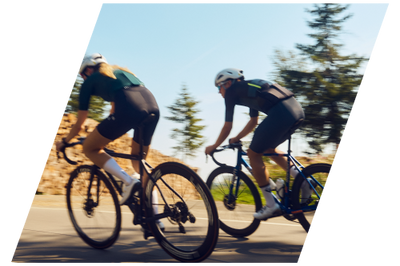
Today we know better. In the professional peloton, 28, usually even 30 mm ; in classics like Paris Roubaix, they go up to 35 mm. Why? More comfort, more grip – and, thanks to lower rolling resistance, higher speeds at the same wattage. Let’s take a closer look at these points.
More comfort
Wider tires offer noticeably greater ride comfort because they can be driven at lower pressure. A wider tire has a thicker profile, provides more cushioning, and absorbs vibrations before they reach the rim. (We’ll revisit the topic of vibration absorption when we discuss rolling resistance.)
Example Silca Pressure Calculator
Silca has a "Tire Pressure Calculator” that calculates the optimal pressure based on vehicle weight, road surface, and speed. “Optimal” here means: lowest rolling resistance.
-
23 mm tires – 80 kg system weight, normal asphalt, moderate speed
o 7.3 bar rear / 7.2 bar front
-
30 mm tires –same specifications:
or 4.8barrear/4.7 bar front
2.5 A difference of just 2.5 bar makes a huge difference in comfort. If you don’t believe it, give it a try. Although comfort could be measured according to ISO 26311, but the subjective perception is so clear that the lab work isn’t necessary.
In short: Wider jacket → lower optimal pressure → larger buffer zone and better vibration absorption.
Too little pressure causes the tire to collapse: comfort and cornering grip are lost.
More grip
A wider tire offers more grip when braking and cornering. A larger contact patch plus better adaptation to micro-irregularities means: more rubber is in contact at the same time. In addition Silca , SRAM also offers a pressure calculator that takes into account dry and wet conditions. However, too low a pressure causes the tire to flex and can even cause it to come off the rim – which results in a loss of grip and a risk of a flat tire.
Rolling resistance and its factors
Before we examine rolling resistance for different tire widths, let’s look at the factors that generally determine rolling resistance—regardless of tire width.
Rolling resistance is determined by two factors: vibration absorption and the work done by the tire with each contact with the road. Vibration absorption describes the tire’s ability to cushion small bumps in the road. In doing so, the tire deforms minimally and conforms to the bump (e.g., e.g., rough asphalt) and reduces the difference in height. As already mentioned in the Comfort section , high vibration absorption not only leads to greater comfort but also to lower rolling resistance
If the tire is inflated (too) hard, bumps are not sufficiently absorbed—resulting in increased vibrations, reduced comfort, and higher rolling resistance***. Such micro-vibrations, which riders and the bike instead of the tire—are called impedance losses. A tire that is overinflated therefore generates high vibrations, i.e., high impedance losses.
*** Assumingthat you are driving on a surface with at least minor unevenness (e.g. e.g., asphalt). On glass or metal, higher tire pressure would result in lower rolling resistance.
A tire that is underinflated, on the other hand, significantly , which also increases rolling resistance. "Walking" can be equated with "deformation": A tire that is too soft deforms excessively with every contact with the ground. This excessive deformation generates friction losses within the tire, which increase rolling resistance. In addition, energy must be expended after rolling to return the tire to its original shape—this is referred to as hysteresis losses.
Let’s summarize briefly:
Rolling resistance is determined by two factors:
1. Vibration absorption: The tire absorbs small bumps. Too high pressure → poor absorption, more vibration = higher impedance losses.
2. Walk-through (hysteresis): Any deformation of the carcass costs energy. Too low pressure → excessive flexing → higher hysteresis losses.
Overinflated = high impedance losses.
Inflated too softly = high hysteresis losses.
What does that mean in practice?
If a coating is (too) hard, it has almost no hysteresis losses (it hardly deforms), but very low vibration absorption (high impedance losses). If it is (too) soft, it does offer high vibration absorption, deforms and compresses a great deal, but.
So you have to find the "happy medium," where both effects are combined to their lowest extent—the optimal tire pressure. This one optimal pressure; it depends heavily on the nature of the road surface and the tire width .
As a general rule: Impedance losses (high rolling resistance with tires that are too hard) are significantly more significant than hysteresis losses (high rolling resistance with tires that are too soft): “(…) as you can see on the new asphalt surface, being 10 psi below the breakpoint only costs 1 W, being 10 psi too high costs 9 W. The coarse asphalt followed the same pattern.” (Silca¹)
¹ https://silca.cc/en-eu/blogs/silca/tire-pressure-calculator-explained
This is often the main reason why wider tires have lower rolling resistance than than narrow tires.
Wider tires offer the advantage that they can be driven with lower tire pressure, which results in lower rolling resistance , while simultaneously minimizing hysteresis losses. In other words: low vibration combined with low deformation = lower rolling resistance. The greater volume of a wider tire distributes the load more evenly, and the carcass retains its shape even at lower pressure.
To illustrate rolling resistance for different tire widths at optimal pressure, we recommend visiting rollingresistance.com: There, the Continental GP 5000 S TR in sizes 25, 28, 30, and 32 mm. Result: The wider the tire, the lower the rolling resistance at the same pressure. A wider tire thus offers greater comfort with the same or even lower rolling resistance (e.g. e.g., 11 W at 25 mm / 5 bar vs. 9.4 W at 30 mm / 5 (cash).
https://www.bicyclerollingresistance.com/specials/grand-prix-5000-s-tr-comparison
Which coat should I choose?
“It depends.” Another study by RollingResistance shows that the rim width also plays a role: The fastest ratio of tire width to rim width is around 72 %. So, with a 21 mm rim width, (e.g. e.g., our CC50 R), the actual tire width would be approx. 29 mm is optimal; at 22 mm (COMP AR) approx. 30.5 mm.*
https://www.bicyclerollingresistance.com/specials/rim-width-test
*Excluding aerodynamic factors—more on that in another post.
However, the differences are less than 0.5 W per tire at ~30 km/h. Those who prefer more comfort should ride the CC 50 R at 30 km/h, and on the COMP AR 32 mm. If you're looking for maximum aerodynamics, choose 28 mm (CC 50 R) or 30 mm (COMP AR). Why? More on this in the Aero article.
In addition, when choosing a tire width, it is always important to consider the ETRTO recommendation. Accordingly, a rim with a 21 mm rim width tires with 25–58 mm are approved. More on this at https://www.continental-reifen.de/tire-knowledge/tire-rim-combinations-etrto-standards/
In upcoming posts, we will examine different rim widths and their impact on aerodynamics when selecting tires, as well as the interplay between rim depth and susceptibility to crosswinds, and tubeless vs. tubes and much more.
Do you have questions, comments, or ideas? Then feel free to email us at info@leeze.de with your request.
Sources:
– Silca Tire Pressure Calculator
– bicyclerollingresistance.com (GP 5000 S TR Comparison, RimWidth Test)https://silca.cc/en-eu/blogs/silca/tire-pressure-calculator-explained
https://www.bicyclerollingresistance.com/specials/grand-prix-5000-s-tr-comparison
https://www.bicyclerollingresistance.com/specials/rim-width-test
https://www.continental-reifen.de/tire-knowledge/tire-rim-combinations-etrto-standards/